Maple Syrup for Sweet Occasions

Text and Photos by Licia Canton

The year we celebrate our nation’s 150th anniversary also marks my 50th year in Canada. I must confess that, when I was growing up in Montreal-North, maple syrup was not a staple in my Italian parents’ household. We never had pancakes, waffles, muffins or whatever else my non-Italian neighbours typically ate. I cannot remember my first encounter with maple syrup, but I remember going to la cabane à sucre (the sugar shack) with my parents and sister. I would have been in my late teens.

Maple syrup was never on my mother’s grocery list. I always thought of it as a luxury when I was little. But my Montreal-born husband remembers it differently. “We often had pancakes with maple syrup for breakfast,” he recalls. “My mother bought maple syrup at the Jean-Talon market all the time. It wasn’t expensive in those days, before producers banded together to control the price. A few cents for a jug.”

sirop d'erable

Today, in our Venetian-Calabrian-Canadian home, we always have maple syrup in stock. I routinely buy it when I see that it’s running low. I’ll admit that I add a little to my very healthy (but a little bland) oatmeal. And every Wednesday morning I make French toast for my kids. Why Wednesday? It’s a sweet way to acknowledge that we’ve made it to the middle of the week. And on Wednesdays my own breakfast consists of egg whites and spinach. What am I supposed to do with the yolks? I don’t have enough time to make sbattutino, so I add a little milk to the yolks and make lots of French toast with strawberries, maple syrup and lots of caffellatte.

Often, when I travel, I purchase maple syrup products at Montreal’s Trudeau Airport. I usually buy the maple-leaf-shaped bottle and maple candy – the typically Canadian things I can bring to friends and acquaintances I visit abroad. When I landed in Tokyo last July, I brought maple syrup to my friend Yakup (originally from Turkey) who greeted us at the airport. We hadn’t seen each other since 1990, when we were both studying at the University of Kent at Canterbury. My children were impressed that Yakup and I were still in touch. Yakup had given me a “forget-me-not” cup and saucer when I left Canterbury. Growing up, my children knew him as “the friend who gave you the cup we cannot touch.”

A few days later, I gave another bottle of maple syrup to our friends Taka and Hiro, who took us on a tour of Mount Fuji. Taka and my husband were in graduate school together in Montreal. A maple-leaf-shaped bottle of the sweet golden liquid would bring back memories of our vast and friendly land, the cold, white winters, skiing and sugaring off. At least that’s what I hoped.

Land of Cakes

“Canada is the land of cakes.” So states Catharine Parr Traill confidently in the cake section of her Female Emigrant’s Guide of 1854.

It is to one such recipe, for “cup cake” that I turn for this second installment of economical cooking with Traill. It’s “about as good as pound-cake, and a great deal cheaper” says Traill before getting down to the business of ingredients and instruction:

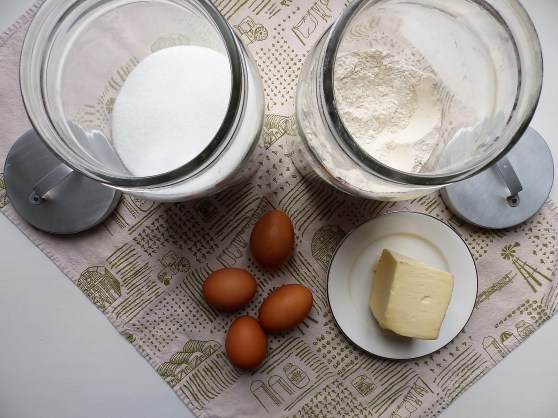
Three cups of flour, one cup of butter, two cups of sugar, and four eggs, well beat in together, and baked in pans or cups. NOTE.—This is a regular American cake.

eggs

eggs, flour, sugar, butter

Not a note about temperature and timing here but readers of The Female Emigrant’s Guide will come to know that there are all kinds of subtleties of skill that comes with hearth cooking. Fires are hot, quick, clear, brisk, slow and slack and dishes may be placed on or near to achieve the desired effect. Adjusting temperatures is not, as it turns out, a mere matter of turning a dial.

Shelley and I wanted to highlight Traill’s Guide this past month because

  1. It pairs so beautifully with the Culinary Historians of Canada, Canada 150 challenge
  2. McGill-Queen’s University Press is soon to release a new re-set edition of the Guide, under the expert guidance of Nathalie Cooke and Fiona Lucas. Look for it this coming June with the title Catharine Parr Traill’s The Female Emigrant’s Guide, Cooking with a Canadian Classic.

Fiona Lucas joins us below to tell us a little about the book and also speaks to this week’s recipe.

We include encouragement to recreate her recipes, such as a measurements chart and shopping advice. We also explore Canadian foodways in the mid-nineteenth century in relation to today’s tastes and techniques. Take the word “cake.” In Traill’s English youth early in the century, the term “cake” encompassed three basic categories: plum cake (large yeasted or egg-raised fruit breads; also called “great cake”), pound cake (plain butter cakes), and sponge cake (plain cakes made very light by the addition of eggs, yolks and whites beaten separately until very airy; also called biscuit cake and savoy cake). It was also a generic word for any sweet, flour-based baked item, what we’d call a cookie today. By her middle-aged years in Canada, “cake” was encompassing new American forms, like “cup cake.”

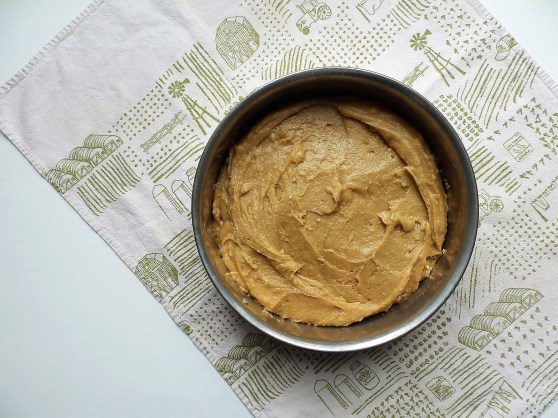
batter


dishes

Cup cakes were dollops of plain batter baked in little cups, even literally teacups, often paper-lined. Directions generally stipulated one cup of butter, two cups of sugar, three cups of flour, and four eggs, well beaten together, and baked in little pans or cups. This contrasted with the old British pound cake and its one pound each of butter, flour, and sugar. Fancier cup cakes boasting fluted papers and a bit of icing anticipated the decorative icing-laden treats that became briefly all the rage a few years ago. Traill’s recipe was taken without attribution from Mrs Child in The American Frugal Housewife (1832).

ready to bake

For her British immigrant readers, Traill’s cake recipes were distinctly North American in three ways. They were mostly measured by volume (cups) instead of weight (pounds); raised with chemical pearlash, saleratus, or soda, not yeast or multiple eggs; and moistened with molasses, milk, or sour cream rather than softened butter. Inexpensive, quick, small, and simple, with few eggs to whisk, they were very unlike the fruit-laden, yeasted great cakes of her Suffolk childhood. In other words, exactly what busy mothers in the bush with no servants needed.

baked cake

Belying the notion that white sugar was costly and unavailable, her cakes were amply sweetened with it, brown and maple sugars being substituted only if necessary, although sometimes molasses was texturally preferable, as in gingerbreads and Indian cakes.

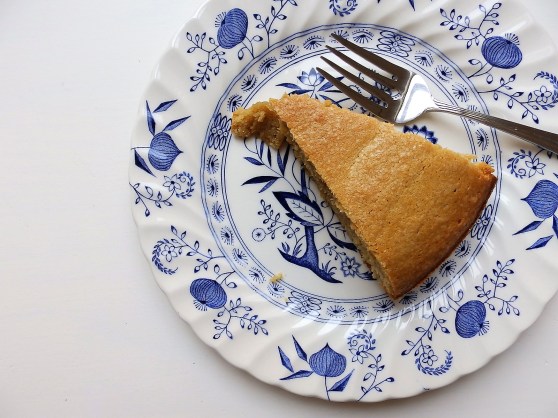
a slice

Text by Fiona Lucas and Alexia Moyer

Photos by Alexia Moyer


Fresh Eggs and Polenta Chips

The CHC’s Canada 150 Blog Challenge for the month of February is: doing without. Last week, Shelley sought advice on the matter from the redoubtable sisters of the backwoods, Catherine Parr Traill and Susanna Moodie. This week, Licia Canton has contributed another story of emigration: from sunny Cavarzere, in the province of Venice to Montreal- North. This is a story about missing home (and eggs fresh from the chicken coop).

by Licia Canton

I have always felt the need to go back “home” – to retrieve the tastes and smells I left behind in my hometown of Cavarzere, in the province of Venice. I was only four years old when my family moved to a basement apartment in Montreal-North. I missed the sunny, rural setting we left behind. I cried a lot that first year.

I cried on my fifth birthday in February 1968. There’s a silent film of me in front of a big cake. My father is encouraging me to blow out the five candles but all I can do is cry. Maybe it was the room full of people from our hometown, none of whom were related to me. Maybe I cried because the cake did not look like the one I had had on my fourth birthday. Maybe I was just unhappy after being uprooted and replanted in a foreign land at an early age.

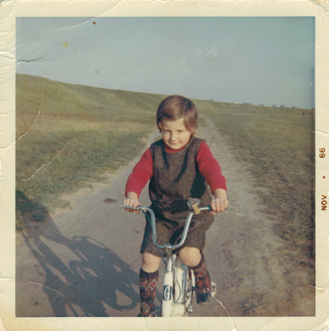
They say I was a talkative and adventurous child in Italy. But in Canada I missed my grandparents, aunts, uncles and cousins. I missed a whole town full of people who knew who I was and who escorted me back home whenever I ventured to the piazza on my Graziella, the little white and blue bicycle I still have 50 years later. That bicycle was the symbol of my freedom. I could go anywhere, and I was safe. In Montreal, I was cooped up in a tiny, cold apartment. My parents wouldn’t let me go out to play. Big cars went by fast, even on des Récollets Street where we lived. I couldn’t play in the backyard because it was reserved for the owner of the duplex who lived upstairs.

licia-on-bike-1966

I especially missed the foods that I was used to in Cavarzere, those my mother couldn’t replicate. The bananas purchased at Steinberg’s grocery store did not taste like the bananas in Italy. They were big and odourless. The oranges felt like plastic. They didn’t taste right either. Cherries were hard to come by. My mother purchased red and green candied cherries one time. I still recall my frustration at the sight of them. That’s not what I wanted. I did not say so because I was sure my mother had spent a pretty penny for them. She ended up making a cake with them.

Mostly, I missed my daily breakfast routine. I fed myself because my mother was busy with my baby sister, three years my junior. Every morning I went into the warm, smelly chicken coop. The rickety door alerted the chickens, and they all scattered about when I walked in. I looked into every nest before choosing my egg. It was always a little dirty but very warm in my hand. Tap, tap. I cracked it open and drank it on the spot. Yes, there were eggs at Steinberg’s and at the dépanneur at the corner of des Récollets and Prieur streets, just a short walk from our basement home. But they were cold and spotless. Not what I was used to. My mother appeased me by making sbattutino.

Back then, I also missed my grandmother’s polenta crusts: ƚe croste del paroƚo as we call them in Venetian dialect. Every day Nonna Gemma made a big pot (paroƚo) of polenta for her numerous family members. Once the huge polenta was laid out to be eaten, the residue dried up in the pot. She let me scrape the crusts. I liked the polenta chips more than the polenta itself. The chips were a treat for me.

My mother made polenta in Montreal, but she did not have my grandmother’s copper pot. There were no polenta chips to scrape off. I was disappointed whenever I saw the pot soaking in sink.

In the early years, every time I came back to Montreal after having vacationed in my hometown I had to get used to the fruit again. For a long time, that bowl of fruit at the centre of my mother’s table provoked a sense of loss in me.

That is no longer the case today. In recent years, I have seen similar bowls of fruit in the homes I’ve visited in Italy. Italians, too, buy fruit at the supermarket. They also buy ready-made polenta.

Even today, when I am sad or disappointed I crave my mother’s sbattutino. Of course, it is not the same colour as the sbattutino she made for me with eggs from the chicken coop. But I cannot complain about my parents’ decision to emigrate. I know now that it was the right decision: it gave us all a new beginning and many years of happiness. I have gotten over my sadness. And I am also grateful that my early childhood memories are so full.

Text and Photo by Licia Canton

Monkey Beach Clams

Eden Robinson’s Monkey Beach is set at the head of the Douglas Channel, in Kitamaat Village, “with its seven hundred Haisla people tucked in between the mountains and the ocean” (5).

“At the end of the village is our house,” explains narrator Lisamarie Hill. “Our kitchen looks out onto the water” (5).

The mountains and the ocean not only surround but also supply the Hill family’s kitchen with such riches as oolichan, made into grease; crabs, boiled; cockles and clams, put up into jars. Not to mention q°alh’m shoots with their taste of fresh green peas, ci’x°a or wild crabapples, Pipxs’m and sya’k°nalh blueberries, and soapberries or uh’s whipped into a foam.

Lisa is an indifferent cook in her home economics classes but a fast learner when it comes to cleaning and smoking sockeye salmon in the yard with her mother and grandmother.

It is a challenge for the literary cook to replicate any of the dishes in this novel. In some cases, the ingredients are endangered. Commercial fisheries for Oolichan, for instance, are closed. Or, they are particular to the west coast. Finally, they require a wealth of acquired knowledge and technique to forage for and prepare them.

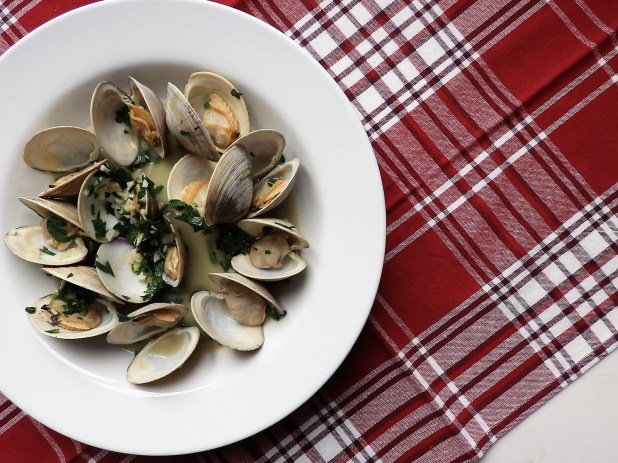
Lisa had her grandmother, Ma-ma-moo. I had Mémère. So, in the interest of drawing from grandmotherly wisdom, I have made clams for you today. And I have steamed them in wine and served them with French fries because that was what my grandmother did.

clams

garlic

garlic, lemon, butter, parsley, wine

Susan Musgrave’s A Taste of Haida Gwaii includes very helpful instructions on how to purge clams – with salt water if you please. Now I can successfully avoid the debacle that is sandy clam chowder.

sea salt for purging

purging sand

And this, some few minutes after cooking . . .

with fries

Robinson, Eden. Monkey Beach. Toronto: Vintage Canada, 2001.