“Polenta and Radicchio: Growing up Venetian in Montreal-North”

Author/editor Licia Canton’s previous post on sbattutino was so widely read, we asked her back. She has delivered in the form of polenta and radicchio. Tutti a tavola dear readers.


Few people know that I am a writer with a backup plan. I put myself through school (all the way up to and including university) working in my parents’ butcher shop. I can handle several types of butcher’s knives. I can debone a pig’s head and make a variety of cuts out of a pork shoulder or a side of beef. I’ve always found solace knowing that, if times might get really tough and I wouldn’t be able to pay the bills by working with words, I could always seek employment in the meat department of a supermarket.

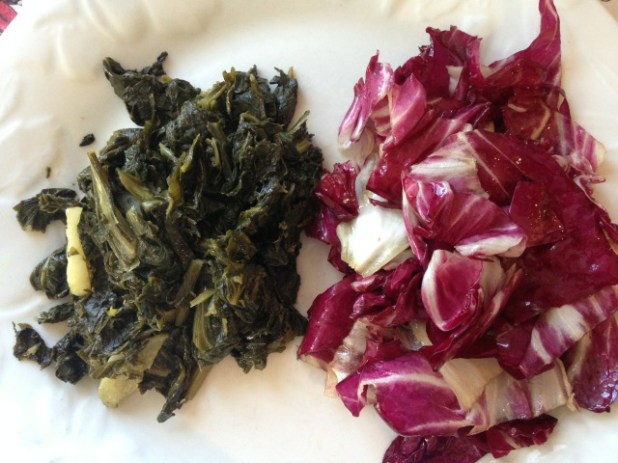
I grew up in a Venetian-Canadian family. My parents owned a butcher shop at the corner of Sabrevois and Rome streets in Montreal-North. We ate a lot of meat. Whatever was not sold ended up in our plates at dinnertime. Fillet mignon was a rare treat. We ate polenta and radicchio, staples in my parents’ hometown. It was my responsibility to prepare dinner after school and lunch every second Sunday. I made the meat sauce for the pasta, what we called el sugo. (Sauté onion and celery, then brown the minced or cubed meat; add salt, pepper and diced fresh or canned tomatoes; and let it simmer for one hour.) I was taught that every recipe takes a long time to make. Polenta, for instance, needed to be stirred nonstop. Years later, I found out that there is a shortcut to making polenta. Simply add salt to boiling water, add the cornmeal, put the lid on the pot and let the polenta cook by itself. No need to stir for 30-45 minutes. I could have gone outside to play while the polenta cooked itself had I known that the end product was the same. I am convinced that my parents taught me the long version because they wanted me to stay inside the house. Some nights, instead of having pasta or soup as a first course we had polenta e latte (milk). Once the polenta was ready, we added spoonfuls to a bowl of cold milk. The polenta warmed up the milk. It was like drinkable cornmeal.

In our vegetable garden, we mostly grew radicchio – our staple vegetable year round. We ate fresh red radicchio until the snow came. Then, we cooked and strained the radicchio, shaped it into balls and froze them. The dark green balls were taken out of the freezer, diced and sautéd in onion. It was rather bitter, but we ate it with meat, polenta, pasta al ragu and wine. My father made his own wine every September. He mixed several types of California grapes. Zinfandel was his favourite.

We children, too, were obliged to drink a quarter or an eighth glass of red wine at dinnertime. I closed my eyes and drank it right away so that I could move on to drinking something else. My sister did not drink anything during the meal: she always tried to leave the table without drinking the wine.

“Come back here, Ester,” my father would say after dinner, as she walked away from the table. “You have to drink the wine. You know that.” She’d go back and gulp it down and then run away.

When I was younger and had nothing to do (read, before my children were born), I liked to make my own pasta and gnocchi just like our mothers and grandmothers used to do. Nowadays, if my Calabrian-Canadian self-appointed chef husband-colleague insists on making dinner as a de-stressor, who am I to argue?

On the menu tonight, as a way of reconnecting to our roots: cooked radicchio, polenta and milk, and pasta al forno. (Not to be confused with lasagna or pasticcio, pasta al forno is a blend of cooked noodles, meat sauce and cheese. The mixture is laid out in a baking dish and cooked in the oven for about an hour or until the top is crusty).


Toasting Vancouver

In a February post on Drinking Food, Alexia Moyer opened with the observation that “Drink of all kinds populates Canadian Literature” and that writer Austin Clarke (via his mother) urges readers to line their stomachs with food before imbibing. Wise advice.

But there are other accompaniments to alcoholic beverages. How about words?

Let’s raise our glasses for a toast…

In The Rituals of Dinner, Margaret Visser notes that the act of toasting has an ancient past. Its meanings and rituals vary depending on the culture. Today, the true delights of toasting are mostly tied to the senses — taste, touch, smell, sight, and sound (257). Visser observes that when we mark an occasion with a toast, we bring people together:

“Clinking glasses—rapping them to call everyone present to attention, or tapping them together when toasting—has always given people pleasure. Clinking one glass against another is making contact, an action we perform precisely because we are not sharing one cup; in doing it we remind ourselves that the wine, now separated into glassfuls, is still one, and we reach out to each other even though we do not hand our glasses on” (258).

Clinking may delight the ears, but so do words, especially poetry.

Yesterday– April 6, 2016–was Vancouver’s 130th birthday. For the next 130 days, the City of Vancouver will be posting fun facts about the city. You can follow along on Twitter #Van130.

To mark this event, a poetic toast seemed in order by way of E. Pauline Johnson (Tekahionwake), who wrote the poem “A Toast” in 1903, praising her adopted western city as the “Queen of the Coast.”

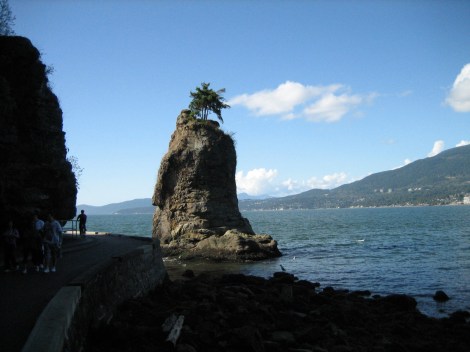
Born in 1861 on the Six Nations Reserve (in Ontario), Johnson spent the last years of her life residing in Vancouver. She is famous for the collection of stories Legends of Vancouver (1911) that were inspired by Chief Joe Capilano of the Squamish Nation. When Johnson died in 1913, she was buried in Stanley Park not far from Siwash Rock.

The sing-song rhythm of Johnson’s “A Toast” expresses merriment and love for this coastal city. In Paddling Her Own Canoe, Carole Gerson and Veronica Strong-Boag comment that the poem’s joyfulness suggests that at the time, Johnson still had “hopes of a more inclusive nation” with respect to Canada’s treatment of the First Nations (215). “A Toast” blends the seemingly simple yet meaningful ritual of raising a glass with Johnson’s dreams for the future of Canadian society.

In the poem, Johnson selects a rare vintage wine, generously fills her cup “to the edge,” and toasts Vancouver’s health, youth, wealth, and future achievements.

So if you’re sipping a glass of wine this week, say a few words of poetry and toast Vancouver at 130.

Then here’s a Ho! Vancouver, in wine of the bonniest hue,
With a hand on my hip and the cup at my lip,
And a love in my life for you. (“A Toast”)

To read Johnson’s poem in its entirety, see Canadian Poetry.

Gerson, Carole, and Veronica Strong-Boag. Paddling Her Own Canoe: The Times and Texts of E. Pauline Johnson (Tekahionwake). Toronto: University of Toronto Press, 2000.

Johnson, E. Pauline. “A Toast.” Canadian Born. 1903. Canadian Poetry.

Visser, Margaret. The Rituals of Dinner. Toronto: HarperPerennial, 1992.


Text and Photos by Shelley Boyd

“Ice-Cream Man”

Food and Sex: The Politics of Exchange in Lynn Coady’s “Ice Cream Man”

by Liana Cusmano

Chicken, ice cream, soup. In Lynn Coady’s short story “Ice Cream Man,” food is exchanged for companionship without allowing for meaningful connection between individuals. The guy at the canteen has been offering the protagonist an ice-cream sandwich – food – for years, making the “same joke since [she was] seven years old” (34). The proverbial ice- cream sandwich is a stand-in for sex, and the guy at the canteen does eventually “give [her] the ice-cream sandwich he’s been talking about all these years” (35). He repays the sex that she routinely gives him with free snacks from the canteen and with rum (37). Food is thus exchanged for company, specifically for sex, but the relationship between the two individuals is based solely on intercourse, involving no depth, intimacy, or intellectual closeness. Later, the man hints that the girl ought to bring him fried chicken (39); suddenly she has become the primary beneficiary of the relationship, and he expects his offer of sex to be repaid with food. He is used to this method of exchange: “Every woman I’ve known has always tried to do nice things for me” (39).

OLYMPUS DIGITAL CAMERA

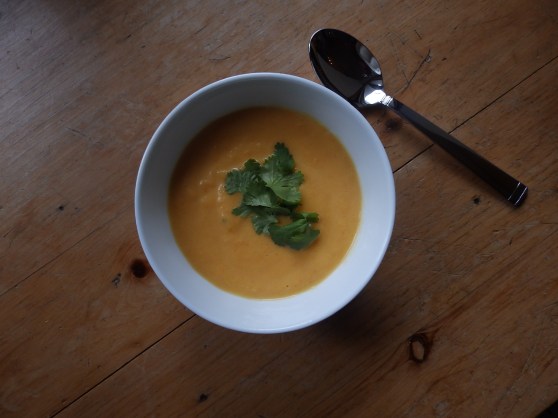
The Soup Trade

The girl’s distant father has a similar attitude when he wants her to eat soup with him; he expects his culinary thoughtfulness to be compensated with company, although “he doesn’t even quite know why that is” (43). The relationships the girl has with the two men in her life are thus based on trading food for human companionship, but she shares no meaningful connection with her so-called boyfriend or with her father – in spite of all the soup and chicken involved.


Coady, Lynn. “Ice Cream Man.” Play the Monster Blind: Stories. Toronto: Doubleday, 2000. 27-43. Print.

Photos by Alexia Moyer


Why Half a Grapefruit?

In Alice Munro’s “Half a Grapefruit,” the fruit is an occasion around which Rose hopes to distance herself from her classmates and from her less-than-desirable West Hanratty origins. No one else had thought to mention grapefruit as breakfast fare during that somewhat ill-conceived classroom discussion.

This grapefruit anecdote, as Sarah Contreras-Wolfe points out below, is also a tool for Munro to demonstrate ways in which Rose and step-mother Flo (gingerly) negotiate their relationship.

Text by Sarah Contreras-Wolfe

Flo and Rose bond by hiding their weaknesses from one another.

Rose never talks to Flo about the grapefruit incident. Rose would not share something that would reflect poorly on herself: “Half-a-grapefruit she never got to hear about. Rose would not have told her anything in which she did not play a superior, an onlooker’s part. Pitfalls were for others, Flo and Rose agreed” (Munro 54). Munro includes the story about the half a grapefruit to demonstrate Flo and Rose’s mutual belief that personal hardships should not be discussed between the two of them, not even when it comes to Rose’s father’s illness.

When Rose is talking to Billy Pope about her father, she speaks candidly, which she would not do with Flo: “’Not if he has lung cancer,’ Rose said firmly. She had never said that before and certainly Flo had not said it” (66). When Flo is telling a story about a woman with second sight who suggested her mother eat green onions to help with her nerves, she is also direct, like Rose: “It wasn’t nerves at all it was cancer, so what good they did I don’t know:’ Flo’s voice climbed· and hurried on, embarrassed that she had let that out” (69).

What doesn’t get said in these conversations between Rose and Flo is the meat, if you will, of this story.


Munro, Alice. “Half a Grapefruit.” Who Do You Think You Are? Toronto: Penguin, 1996. 51-72. Print.

Mills, Amanda. “Whole ceramic bowls each containing a half a grapefruit free stock picture”. 2015. CC0. <a href=”http://www.public-domain-image.com/free-images/still-life/whole-ceramic-bowls-each-containing-a-half-of-a-grapefruit&#8221; title=”Whole ceramic bowls each containing a half of a grapefruit public domain image”>Whole ceramic bowls each containing a half of a grapefruit</a>