This week’s recipe comes from The Johnson Family Treasury: A Collection of Household Recipes & Remedies 1741-1848, edited by Nathalie Cooke and Kathryn Harvey, transcribed by Erin Yanota, with forward by Lynette Hunter.
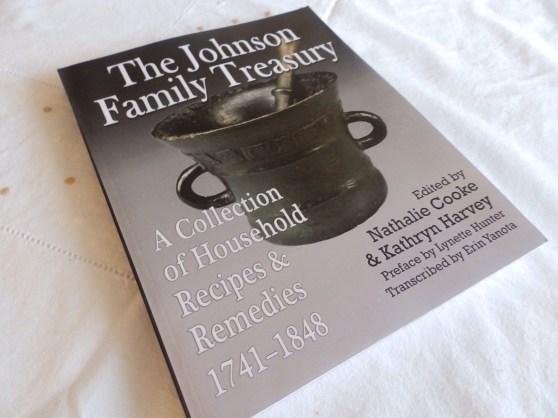
Begun in Hertfordshire and London in the mid-eighteenth century, the manuscript found its way to Canada and into recipe collector Una Abrahamson’s hands and, eventually, to the University of Guelph’s rare book collection where it was taken up by Cooke.
This recipe book is the product of many hands and the editors have seen fit to preserve the visual proof of multiple contributors. Recipes appear in both typescript and in their original handwritten form.
Built over a period of over one hundred years, this collection is rich with instructions for stewing carp and lamprey, making Ratafea cakes and alleviating all manner of diseases from scurvy and pleurisy, to weakness in the ankles and cancer. This is indeed a treasure trove for scholars and amateurs alike interested in the history of medicine as tested by homemakers.
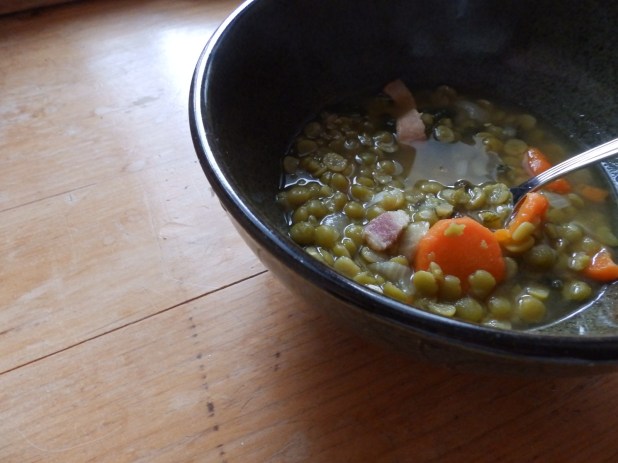
As tempting as it would be to soothe a sore throat with a plaster made from mutton suet, butter and bees-wax, I have elected to try my hand at pea soup. This is partly to do with the fact that the temperature here in Montreal has dropped of late to a brisk -20. At -20 nothing but soups and stews will do. Furthermore, this recipe calls for ingredients one can easily find in one’s “larder”.
Here, in one compact paragraph are the ingredients and (somewhat) vague instructions, transcribed by contributor C (as she is identified by the editors) and contributed by a certain Captain Torin, who has also provided a recipe for hard biscuits. I know not whether Torin’s captaincy was held by sea or by land. That the gentleman had excellent taste in soups, however, is undeniable. This is a pea soup to warm your cockles.
Dry Pea Soop
When you have strain’d off your Peas, stew in a little of that liquor, some sorrel, spinage, Beet leaves, Parsley, Carrot & leeks chopt together (a very little time will do them) in the mean time cut some sallery [celery] into pieces and boil it in the soop, and when the herbs are stewed put the soop to them; then fry a little fatt Bacon, in which you will fry your toasted bread to put into the soop.

OLYMPUS DIGITAL CAMERA

OLYMPUS DIGITAL CAMERA

OLYMPUS DIGITAL CAMERA

OLYMPUS DIGITAL CAMERA

OLYMPUS DIGITAL CAMERA
Quick recipe note: If I’ve understood the recipe correctly, Captain Torin calls for the addition of just the pea broth to the soup. Presumably the peas are reserved for some other meal. I’ve included them in this case.
Cooke, Nathalie, Kathryn A. Harvey, Lynette Hunter, and Erin Yanota. The Johnson Family Treasury: A Collection of Household Recipes & Remedies, 1741-1848. , 2015. Print.
Text and Photos by Alexia Moyer





 Canadian Literary Fare