It’s Not Me, It’s the Food: The Edible Woman by Margaret Atwood


Marian MacAlpin is a normal 26-year-old working woman who, for reasons she doesn’t quite understand, begins to lose her appetite. Initially Marian believes that her distaste for food only encompassesEdible meat, but the aversion progresses so far that eventually she is unable to consume anything at all. Feeling a loss of control over herself and her life, Marian’s mind unconsciously controls the only thing it can: her diet. The novel focuses on the physical manifestations of psychological distress as Marian spirals into a state of personal disassociation made clear by the shift from first person to third person narration in the second part of the novel. The Edible Woman is an appetizing read, which portrays and evokes a sense of hunger for self-identity, self-control, and self-creation. The novel’s title refers to Marian herself, and to the novel’s surprising conclusion, which I won’t spoil for you.

Atwood, Margaret. The Edible Woman. 1969. Toronto, Canada: McClelland & Stewart, 2010. Print.

Written By: Teia Giacomello

Teia Giacomello is in her final semester of her English degree at Kwantlen Polytechnic University; she plans to study Canadian literature at the Masters level.

Savoury, Spicy Goulash inspired by Winnipeg

The food arrived, the hot steaming fragrance of it filling the room, savoury and varied and as spicy as an adventure, rich with the treasured cooking-lore of the whole of Europe . . . Soup came first. But this was merely to prepare the guests for the more serious business of eating. Immediately after, there appeared an enormous bowl of chicken goulash, steaming hot in its red sauce of paprika, with great fat globules floating on the surface. As a side dish for soaking up the gravy there was a mound of home-made noodles, accompanied by small green gherkins with flesh clear as glass from their long immersion in brine, with the pungent aroma of dill and garlic and the young tender leaves of horse-radish.

John Marlyn’s Under the Ribs of Death, 99

Recipe Notes (by Alexia Moyer)

This passage from John Marlyn’s Under the Ribs of Death – set in Winnipeg’s North End – is a favourite of mine.

Those moments in which protagonist Sandor Hunyadi takes pride in his community’s output are few. This is one of them. There is no embarrassment or dissimulation here. This table of delicacies the result of the skill, generousity and ingenuity of Frau Hunyadi and her neighbours – is not found wanting. There is only pleasure and satiety.

Admittedly, I also chose this passage because I wanted to make goulash. Or, more precisely, eat it.

I started with 3 peppers, chopped.

5 cloves of garlic, minced.

Continue reading

Pile of Bones

For our final entry on Regina, we are featuring

 Regina resident and writer Jes Battis.

Jes Battis is the author of a series of novels featuring protagonist Tess Corday, an occult special investigator who lives and works in Vancouver. His first book, Night Child, was shortlisted for the 2008 Sunburst Award for Excellence in Canadian Literature of the Fantastic. In addition to his creative work, Battis is an Associate Professor who teaches in the English Literature and Creative Writing programs at the University of Regina. In the academic world, Battis has authored and edited a number of monographs and collections, including most recently Mastering the Game of Thrones: Essays on George R.R. Martin’s A Song of Fire and Ice (McFarland, 2015), which he co-edited with U of R professor Susan Johnston.

Originally from British Columbia, Battis has found inspiration in his adopted home on the prairies. Under the pen name Bailey Cunningham, Battis authored the 2013 fantasy novel Pile of Bones: A Novel of the Parallel Parks, which is set in Regina.

51OHHa4MW7L._SY344_BO1,204,203,200_

Some of you may not be aware that Regina was once called “Pile of Bones.” The City of Regina’s website explains the background of this name and its connection to traditional aboriginal foodways prior to the agricultural settlement of the prairies and the near-elimination of the bison:
Continue reading

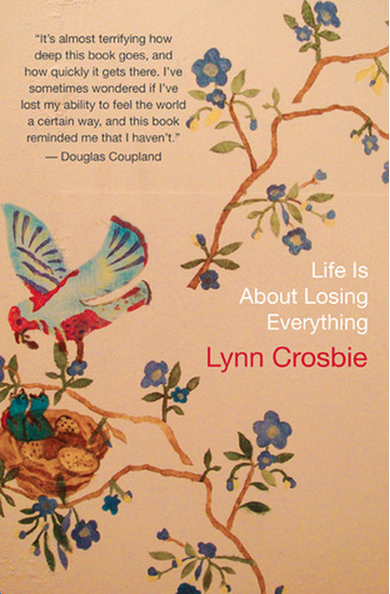
Life is About Losing Everything by Lynn Crosbie

“Every book is about cancer or dieting,” the narrator of Life is About Losing Everything observes while perusing a bookshop (180). Crosbie’s text fits into the latter camp, featuring a protagonist whose aging body has fattened and fails her—despite her many forays into dieting à la Jenny Craig. Part memoir, part fiction, part poetry, part prose, Life is About Losing Everything is written as a series of vignettes that document a painful seven-year period in the life of a middle-aged woman with a fraught relationship with food, alcohol and drugs, and sex—with nourishment of all kinds. What is told is a non-continuous, fluid spectrum of feeling, of physical touch, and a body hungry for it.

Crosbie, Lynn. Life Is about Losing Everything. Toronto: Anansi, 2012. Print.

Written by: Valerie Silva

Valerie Silva is currently in her final year of the Master’s program at McGill University, where she studies contemporary Canadian literature. Her current research focuses on affect, objects, and the body in contemporary Canadian life writing.