Food in Canadian Film, Part 3: Les bons débarras

by Natasha Shalliker

Throughout Les bons débarras there are many scenes in which characters interact over food and drink. However, protagonist Manon – the troubled and trouble-making daughter of single mother, Michelle – does not eat at all throughout the course of the film, and her lack of appetite becomes a subject of narrative concern. For Manon, food is a vehicle of control and a way for her to exercise power as she works to make her dream — to have her mother’s love all to herself — a reality.

One of the most pivotal scenes of the entire film centres on Manon’s refusal to consume a hot dog during her birthday party. During this scene, Manon refuses the hot dog in the same moment that her rude, cruel, manipulative comments and rule-breaking behaviour come to the fore; she tells her mother that Michelle’s boyfriend has molested her. Although we have no way of knowing whether or not this is true, Manon’s manipulative behaviour throughout the film causes us to doubt the veracity of her statement. As a result, Michelle ends her relationship with Maurice, which means that Manon can monopolize her mother’s attention once more.

OLYMPUS DIGITAL CAMERA Continue reading

Food in Canadian Film, Part 2: J’ai tué ma mère

by Samantha Nardi

The plot of this film is driven by the incessant arguments of mother Chantale (Anne Dorval) and son Hubert (Xavier Dolan), from issues as small as the noise the mother makes while she eats, to the more serious argument that arises when she discovers her son’s hidden homosexuality. These scenes, among others in the film, are marked by the presence of food. Mentions of food, the presence of food in key moments, and most importantly, the multiple dinner scenes throughout are catalysts to the plot’s highly emotional and volatile plotline. Within a traditional familial sit-down dinner setup, these food scenes are the perfect backdrop to highlight minor grievances between mother and son. The opening sequence, framed through Hubert’s skewed perspective in a deliberately heavily edited format, is key in establishing the importance of food in the film.

Continue reading

Food in Canadian Film, Part 1: I’ve Heard the Mermaids Singing

The following post is the first of a five-part miniseries on food and contemporary Canadian film, prepared by students from Olivia Heaney’s ENGL 393 Canadian Cinema course at McGill University. Bon Film.

I’ve Heard the Mermaids Singing

by Jackie Halloran Cooper

This film follows Polly Vandersma (Sheila McCarthy), a 31-year-old amateur photographer and ‘temp-girl’ whom Gabrielle St. Peres (Paule Baillargeon) hires as an art gallery secretary during their meeting in a Japanese restaurant. Polly’s unsuccessful navigation of what is, for her, an unfamiliar cultural setting, illustrates how an individual’s status can be judged by the sophistication of their cultural taste. Immediately following the restaurant scene, Polly returns to her bachelorette apartment, where the relationship between taste and sophistication is destabilized in her interactions with food, music and objects in her home.

Continue reading

Sbattutino Is Love

We asked Montreal author and editor, Licia Canton, for a recipe and a story. For this Valentine’s Day, why not make sbattutino for the one you love?


“What’s the most important ingredient in this meal?” I grew up with that question.

I did a lot of the cooking after school. I was taught that every meal is made slowly and caringly. Love is the main ingredient to every meal.

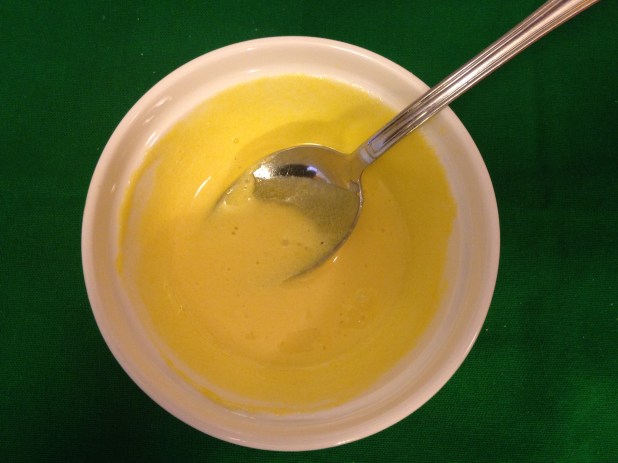
Of all the foods I learned to prepare, from my mother and father, the sbattutino* is the one that I equate with love. My mother’s love. My mother is the only one who has ever made sbattutino for me. It’s quite simple to make really: simply beat an egg yolk with two tablespoons of sugar until it becomes a creamy white mixture and the grains of sugar are no longer distinguishable. Getting it just right involves constant beating for about fifteen minutes.

The sbattutino is comfort food – it tastes good and it’s uplifting. I yearn for my mother’s sbattutino when I am really down. A few years ago, when I was bedridden after a car accident, my mother asked if there was anything she could do for me.

“Can you make me a sbattutino?” I asked. “That’s all I want.”

Very early the next morning, she came over and made my childhood treat for breakfast.

The other day I visited my mother, now 80, in her Montreal-North home. She wanted to feed me, of course. She had left-over polenta and guinea hen. She had homemade biscotti.

“How about a sbattutino?” I asked.

She went over to the kitchen, took out the eggs and the sugar bowl.

We had some on bread – spreadable sbattutino. We had some with espresso and milk. And I also had some with Marsala.

Over the years I’ve made sbattutino for my children, but it just doesn’t taste the same as my mother’s.


*Literally sbattutino means “little beaten one.” (Isn’t it interesting that this drinkable food is uplifting.) The word has its root in the verb sbattere – to beat, as in “to beat an egg.” Sbattuto means beaten. And the suffix “ino” is the diminutive. For those who know a little Italian: it is “lo sbattutino” or “uno sbattutino,” not “il” or “un” because the “s” is followed by a consonant.


Text and Photos by Licia Canton