Food in Canadian Film, Part 1: I’ve Heard the Mermaids Singing

The following post is the first of a five-part miniseries on food and contemporary Canadian film, prepared by students from Olivia Heaney’s ENGL 393 Canadian Cinema course at McGill University. Bon Film.

I’ve Heard the Mermaids Singing

by Jackie Halloran Cooper

This film follows Polly Vandersma (Sheila McCarthy), a 31-year-old amateur photographer and ‘temp-girl’ whom Gabrielle St. Peres (Paule Baillargeon) hires as an art gallery secretary during their meeting in a Japanese restaurant. Polly’s unsuccessful navigation of what is, for her, an unfamiliar cultural setting, illustrates how an individual’s status can be judged by the sophistication of their cultural taste. Immediately following the restaurant scene, Polly returns to her bachelorette apartment, where the relationship between taste and sophistication is destabilized in her interactions with food, music and objects in her home.

Continue reading

Sbattutino Is Love

We asked Montreal author and editor, Licia Canton, for a recipe and a story. For this Valentine’s Day, why not make sbattutino for the one you love?


“What’s the most important ingredient in this meal?” I grew up with that question.

I did a lot of the cooking after school. I was taught that every meal is made slowly and caringly. Love is the main ingredient to every meal.

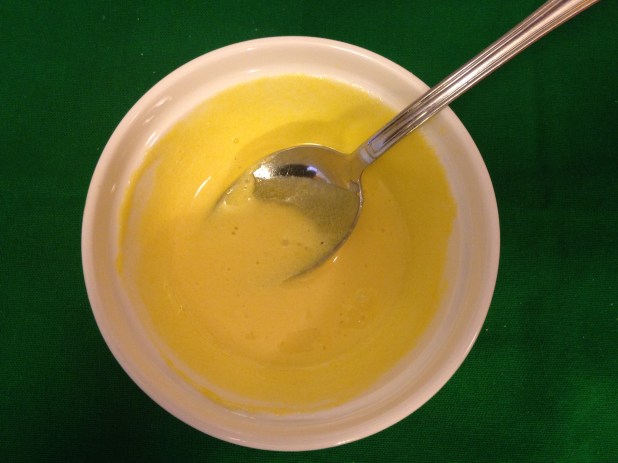
Of all the foods I learned to prepare, from my mother and father, the sbattutino* is the one that I equate with love. My mother’s love. My mother is the only one who has ever made sbattutino for me. It’s quite simple to make really: simply beat an egg yolk with two tablespoons of sugar until it becomes a creamy white mixture and the grains of sugar are no longer distinguishable. Getting it just right involves constant beating for about fifteen minutes.

The sbattutino is comfort food – it tastes good and it’s uplifting. I yearn for my mother’s sbattutino when I am really down. A few years ago, when I was bedridden after a car accident, my mother asked if there was anything she could do for me.

“Can you make me a sbattutino?” I asked. “That’s all I want.”

Very early the next morning, she came over and made my childhood treat for breakfast.

The other day I visited my mother, now 80, in her Montreal-North home. She wanted to feed me, of course. She had left-over polenta and guinea hen. She had homemade biscotti.

“How about a sbattutino?” I asked.

She went over to the kitchen, took out the eggs and the sugar bowl.

We had some on bread – spreadable sbattutino. We had some with espresso and milk. And I also had some with Marsala.

Over the years I’ve made sbattutino for my children, but it just doesn’t taste the same as my mother’s.


*Literally sbattutino means “little beaten one.” (Isn’t it interesting that this drinkable food is uplifting.) The word has its root in the verb sbattere – to beat, as in “to beat an egg.” Sbattuto means beaten. And the suffix “ino” is the diminutive. For those who know a little Italian: it is “lo sbattutino” or “uno sbattutino,” not “il” or “un” because the “s” is followed by a consonant.


Text and Photos by Licia Canton

Drinking Food

Drink of all kinds populates Canadian literature and over the next few months we aim to sample some of it, nay imbibe, though purely in the name of research. The cupboard doors to my liquor cabinet have been thrown open and its contents scrupulously examined . . . for something other than a growing assortment of champagne flutes and, inexplicably, several tiny bottles of Poire Williams eau de vie.

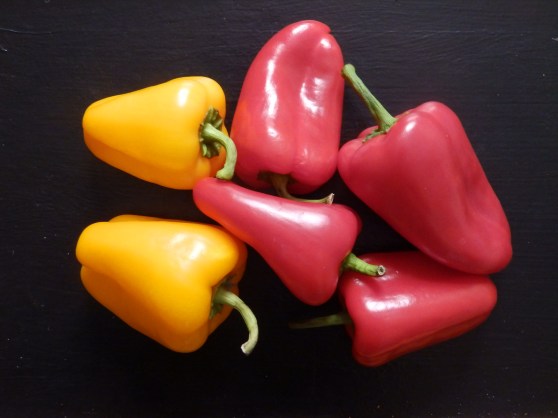
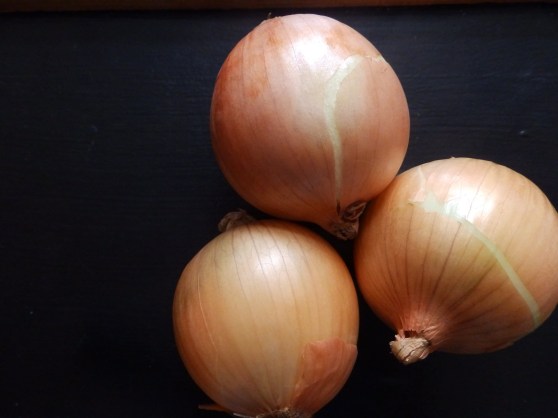
Who better than Austin Clarke to begin the proceedings. In his culinary memoir Pig Tails ‘n Breadfruit, he has dedicated an entire chapter to “drinking food.” For, as his mother sagely advised, “If you know that you going be drinking a lot o’ liquor in the evening, you make-sure that you line your stomach with some good food, hear!” (239). Clarke proposes biscuits with cheese, cou-cou and salt fish, or corned beef with fried peppers and onions.

OLYMPUS DIGITAL CAMERA

I opted for the corned beef. Though I must admit to having later replaced it with a little smoked meat. This is Montreal after all and what is beef if it’s not pickled and smoked.

OLYMPUS DIGITAL CAMERA

OLYMPUS DIGITAL CAMERA

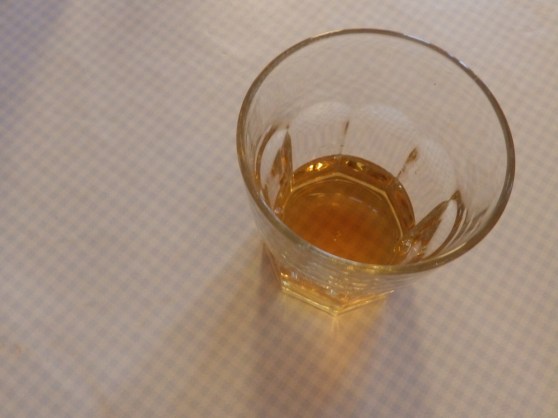
Serve with a side dish of hot pepper sauce and a main dish of rum, “straight, man!” (238).

OLYMPUS DIGITAL CAMERA

OLYMPUS DIGITAL CAMERA


Clarke, Austin. Pig Tails ‘n Breadfruit: Rituals of Slave Food : a Barbadian Memoir. New York: The New Press, 1999. Print.


Photos and Text by Alexia Moyer

To make Dry Pea soop

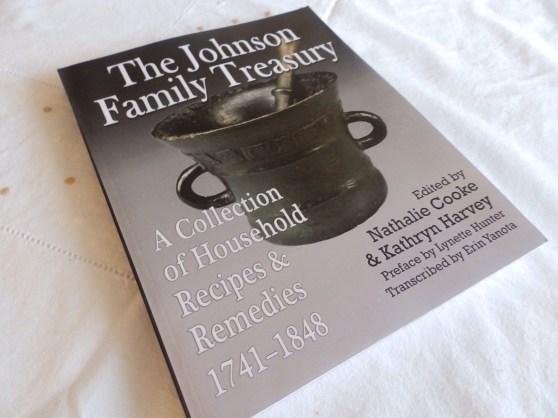
This week’s recipe comes from The Johnson Family Treasury: A Collection of Household Recipes & Remedies 1741-1848, edited by Nathalie Cooke and Kathryn Harvey, transcribed by Erin Yanota, with forward by Lynette Hunter.
Johnson Family Treasury

Begun in Hertfordshire and London in the mid-eighteenth century, the manuscript found its way to Canada and into recipe collector Una Abrahamson’s hands and, eventually, to the University of Guelph’s rare book collection where it was taken up by Cooke.

This recipe book is the product of many hands and the editors have seen fit to preserve the visual proof of multiple contributors. Recipes appear in both typescript and in their original handwritten form.

Built over a period of over one hundred years, this collection is rich with instructions for stewing carp and lamprey, making Ratafea cakes and alleviating all manner of diseases from scurvy and pleurisy, to weakness in the ankles and cancer. This is indeed a treasure trove for scholars and amateurs alike interested in the history of medicine as tested by homemakers.

As tempting as it would be to soothe a sore throat with a plaster made from mutton suet, butter and bees-wax, I have elected to try my hand at pea soup. This is partly to do with the fact that the temperature here in Montreal has dropped of late to a brisk -20. At -20 nothing but soups and stews will do. Furthermore, this recipe calls for ingredients one can easily find in one’s “larder”.

Here, in one compact paragraph are the ingredients and (somewhat) vague instructions, transcribed by contributor C (as she is identified by the editors) and contributed by a certain Captain Torin, who has also provided a recipe for hard biscuits. I know not whether Torin’s captaincy was held by sea or by land. That the gentleman had excellent taste in soups, however, is undeniable. This is a pea soup to warm your cockles.

Dry Pea Soop

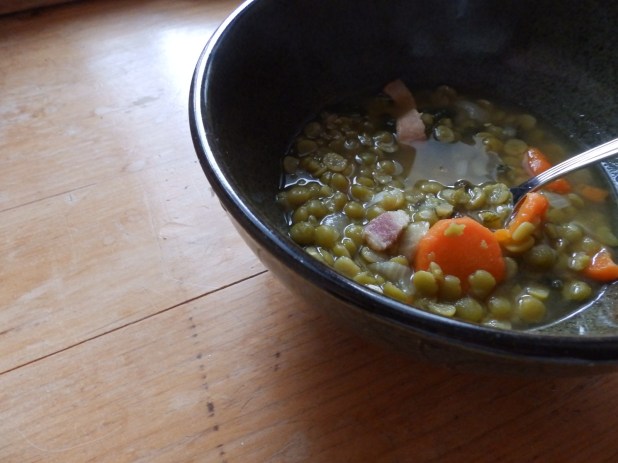
When you have strain’d off your Peas, stew in a little of that liquor, some sorrel, spinage, Beet leaves, Parsley, Carrot & leeks chopt together (a very little time will do them) in the mean time cut some sallery [celery] into pieces and boil it in the soop, and when the herbs are stewed put the soop to them; then fry a little fatt Bacon, in which you will fry your toasted bread to put into the soop.


Quick recipe note: If I’ve understood the recipe correctly, Captain Torin calls for the addition of just the pea broth to the soup. Presumably the peas are reserved for some other meal. I’ve included them in this case.

Cooke, Nathalie, Kathryn A. Harvey, Lynette Hunter, and Erin Yanota. The Johnson Family Treasury: A Collection of Household Recipes & Remedies, 1741-1848. , 2015. Print.


Text and Photos by Alexia Moyer